The master bathroom is the room most Summerlin homeowners use to start and end the day, and for a long stretch in the 2000s and 2010s most of them were built to a builder-grade formula: a small alcove tub-shower combo, a builder vanity with a single sink, fluorescent lighting, and tile choices that aged badly. A spa-style remodel is the antidote to that. Done right, it turns a forgettable utility room into a calm hotel-grade retreat that genuinely changes how the day starts.
The good news is that the spa-style look does not depend on extravagant square footage or imported European fixtures. It depends on a small number of disciplined choices about materials, lighting, layout, and restraint. Here is what actually defines the style, what it costs in Summerlin, and what the most common decisions look like when the project moves from rendering to reality.
What Spa-Style Actually Means
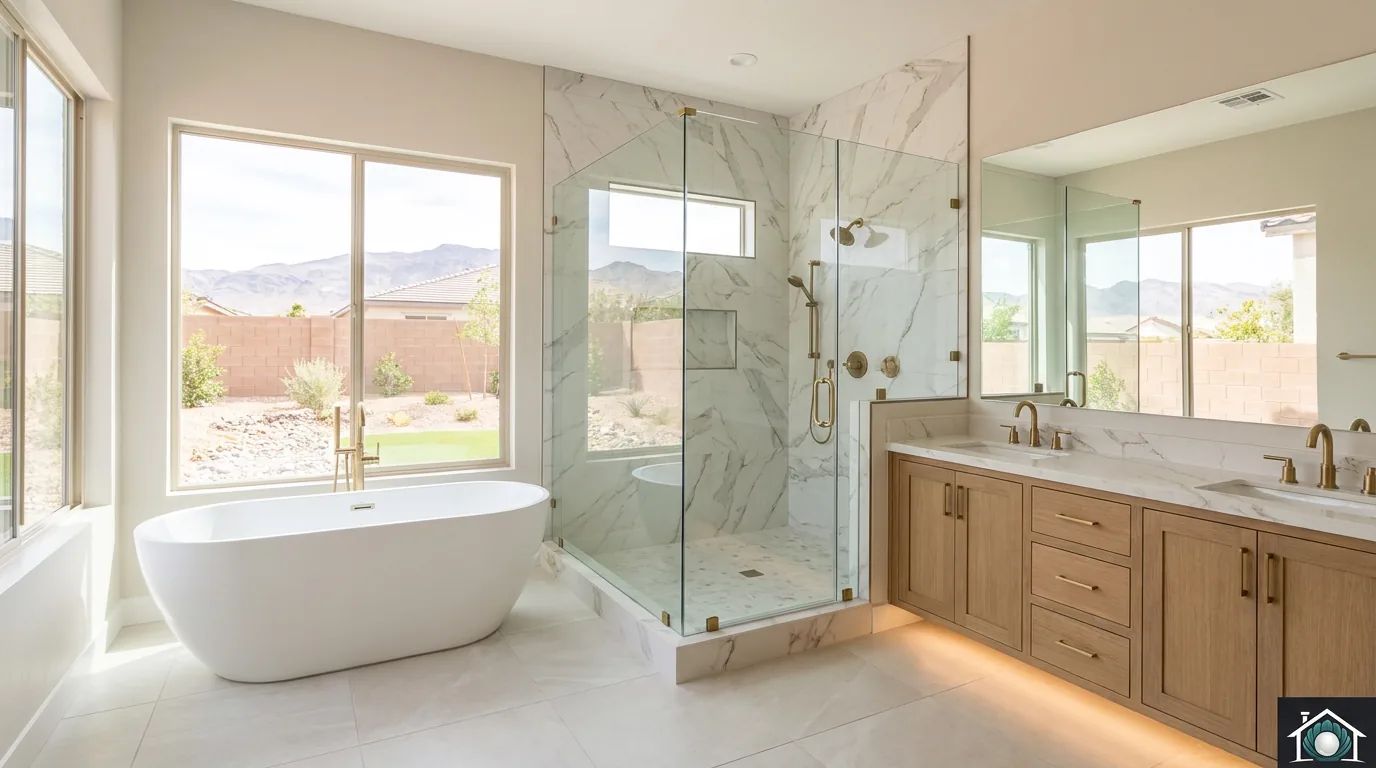
The word “spa-style” gets used loosely in showroom marketing, but the design vocabulary is fairly specific. A bathroom that reads as spa-style almost always shares the same handful of traits: openness in the floor plan, generous natural light, large-format stone or porcelain surfaces, warm and restrained material palette, fixtures that look more like furniture than plumbing hardware, and a deliberate lack of visual clutter.
What it is not: tropical-themed wall decals, scented candles arranged on every flat surface, or rain-shower heads bolted to a bathroom that otherwise still looks like a 2005 remodel. The look is about the architecture of the room and the quality of the surfaces, not the accessories.
When clients ask what a spa-style bathroom feels like, the honest comparison is a well-designed boutique hotel suite. The shower is large enough to step into without ducking around fixtures. The tub is a real piece of sculpture rather than an afterthought wedged against a wall. The vanity has the storage to keep the counter empty most of the time. The lighting flatters everyone and adjusts for the time of day. None of those things require extravagance, but all of them require intention.
The Tub Question
The freestanding soaking tub is the most photographed element of any spa-style bathroom, and it is the single decision that most divides Summerlin homeowners during the design phase. Some want a deep oval or rectangular soaking tub as the anchor of the room. Others see it as a piece of furniture they will use twice a year and would rather spend the floor area and budget on a much larger walk-in shower.
Both choices can read as spa-style. The freestanding tub gives the room a sculptural focal point and an aspirational quality that is hard to replicate any other way - even a buyer who never uses the tub responds to it visually. A tub-less suite with an oversized shower (rain head, bench, body sprays, frameless glass on two sides) is more practical for many households and is increasingly common in Summerlin remodels among homeowners who know themselves.
The wrong choice in either direction is forcing the issue. A freestanding tub crammed into a footprint that cannot accommodate it without blocking traffic looks worse than no tub at all. A massive shower in a small bathroom can feel like a wet room rather than a refined retreat. The starting point is always the actual floor plan, not the inspiration board.
If the tub stays, the practical choices are a deep acrylic soaking tub (lightweight, warm to the touch, good range of shapes, mid-range pricing), a cast-iron or solid-surface tub (premium feel, much heavier, may require structural reinforcement on a second floor, longer fill time), or a Japanese-style deep soaking tub (more vertical orientation, smaller footprint, distinctive look but not for every household).
The Shower as the Real Workhorse
For most Summerlin households the shower gets daily use and the tub gets occasional use, which makes the shower the place where the design and engineering decisions matter most. A spa-style walk-in shower is doing several jobs at once: it has to perform reliably for years of daily use, drain properly, contain water cleanly, and look beautiful when it is empty.
The defining elements are a curbless or low-curb entry, frameless glass on one or two sides, a single material running from floor to ceiling (large-format porcelain or natural stone slab is the cleanest expression), a generous rain head from the ceiling, often paired with a handheld wand on a slide bar, and a built-in bench at a comfortable seated height. Niche storage is built into the wall framing rather than relying on caddies hung from the showerhead.
The body sprays and steam showers that were popular in the early 2010s have largely fallen out of favor in this market. Body sprays are great in marketing photos and rarely get used after the first month. Steam showers add significant cost, require sealed enclosures, and serve a small share of households well. They are still right for some clients but they are no longer a default.
Two practical Summerlin-specific notes about showers: hard water is real here, and frameless glass shows water spots quickly without a treatment. Most quality glass installers include a one-time hydrophobic coating; refresh it every 12 to 18 months. The other note is shower drainage - linear drains at the wall give a cleaner look and let the entire shower floor slope in a single direction rather than the four-way pyramid slope a center drain requires. Linear drains cost a few hundred dollars more and look significantly better.
Tile, Stone, and the Surfaces That Carry the Look
The single biggest visual difference between a builder-grade bathroom and a spa-style remodel is the surface palette. Builder bathrooms typically use 12 by 12 or 6 by 6 floor tile with a contrasting grout color, and the eye reads a grid of small modules. Spa-style bathrooms use large-format tile - 24 by 48 inches is common, and 30 by 60 inches or larger is increasingly used in master bath remodels in Summerlin - with grout joints minimized to a near-invisible 1/16 inch using rectified-edge tile and color-matched grout. The result reads as continuous stone rather than as a tiled surface.
The dominant material palette across current Summerlin spa baths is warm travertine, soft limestone, or marble-look porcelain in cream, bone, and warm grey tones. Cool grey tile has largely cycled out of favor in this market. Wood-look porcelain plank is a strong alternative for the floor if a warmer texture is desired underfoot. Real stone (true travertine, true marble) is still used in higher-end projects but requires sealing on a regular cycle and is less forgiving of water spots and product residue than porcelain.
A common scheme that consistently works is a single large-format porcelain across the shower walls and the floor (carrying the same material from inside the shower out across the bathroom floor visually unifies the space), with the same material on a feature wall behind the tub or vanity. Accent tile - mosaic, zellige, hand-glazed handmade ceramic - works as a small feature in a niche or a decorative band, but used too liberally it starts to read as a tile showroom rather than a refined room.
Vanity, Storage, and Keeping the Counter Empty
A spa-style bathroom is the opposite of cluttered. Achieving that look requires storage that is generous enough to keep daily-use items out of sight, which means the vanity is doing more work than it appears to. Double vanities with deep drawer banks instead of doors-and-shelves are the default in primary suites in Summerlin remodels. Drawer organizers, in-drawer outlets for charging electric toothbrushes and shavers, and a dedicated drawer at the right height for hair tools all matter more than they sound like they should.
Floating vanities (mounted to the wall, with open floor space underneath) are aesthetically clean and make the floor feel larger. Furniture-style vanities with legs read more traditional and store more. Either fits the spa-style language - the choice depends on whether the room leans modern or transitional.
The countertop is usually quartz in a soft marble pattern, real marble for clients who want the look and accept the maintenance, or a sculpted single-piece sink-and-counter (Corian, fabricated stone) for the most minimalist expression. Quartz wins on durability and is the most common choice in this market. Stick to a stone with subtle veining rather than dramatic veining - subtle vein patterns age more gracefully and do not compete with the rest of the room.
Lighting That Does Real Work
Lighting separates a competently remodeled bathroom from a great one. The fluorescent box fixture over the mirror that came with the home should be the first thing to go. A spa-style master bathroom typically runs four layers: ambient overhead lighting (recessed LEDs in a thoughtful pattern, on dimmers), task lighting at the vanity (sconces beside the mirror at face height are far more flattering than overhead light, which casts shadows under eyes and chin), accent lighting (a single fixture over the tub, in-niche LED in the shower, toe-kick lighting under floating vanities), and natural daylight wherever the architecture allows.
The fixtures themselves matter as much as the layout. Color temperature should be warm - 2700K to 3000K is the right range for residential bathrooms. Cooler bulbs in the 4000K to 5000K range read clinical and unflattering. Dimmer compatibility matters because morning routines need full output and an evening soak benefits from softer light. A separate switch for the toe-kick or accent layer alone lets the room transition into low-light mode without leaving the bathroom entirely dim.
Mirrors with integrated LED back-lighting have become a default in newer Summerlin remodels and they perform well. Just confirm the color temperature matches the rest of the room’s lighting before ordering.
Fixtures, Hardware, and Finishes
The faucets, shower trim, towel bars, and hardware are the jewelry of the room. The current finish landscape in Summerlin spa baths has shifted away from the polished chrome that dominated the 2010s. The most-requested finishes today are brushed nickel (still the safest neutral choice), matte black (more contemporary, hides water spots well), and brushed gold or champagne bronze (warmer, dressier, harder to mix with other finishes). Polished nickel, brushed brass, and certain weathered finishes are also in steady use in transitional-style suites.
A consistent rule that holds up: pick one finish for the main fixtures and one optional accent finish, and stick with it across the room. A bathroom with brushed nickel faucets, matte black shower trim, brushed brass cabinet hardware, and polished chrome towel bars reads as chaotic rather than collected.
Quality matters. The shower trim and faucets get touched every day and the difference between a budget fixture and a quality mid-range fixture is felt within a few months. Premium fixtures (Kohler, Hansgrohe, Brizo, Toto and their peers) hold up for 15 to 25 years in this water; bargain fixtures often need replacement at the 4- to 7-year mark.
What the Project Actually Costs in Summerlin
A spa-style master bathroom remodel in Summerlin generally falls into one of three pricing tiers, depending on scope and material selection:
A mid-range refresh on the existing footprint, with quality but not premium finishes (mid-range tile, quartz counters, mid-range fixtures, frameless glass, no plumbing relocation) typically lands in the [$28,000 - $50,000] range. A full spa-style remodel with a layout adjustment, freestanding tub, generous walk-in shower, large-format porcelain throughout, double vanity, and quality fixtures usually runs [$45,000 - $95,000]. A larger primary suite with an expanded footprint, custom shower configurations, premium European fixtures, real stone, custom cabinetry, and heated floors can reach [$90,000 - $180,000+].
These ranges are general industry pricing for the Summerlin market and depend heavily on the size of the footprint, the tier of finishes, and whether the project requires structural work, plumbing relocation, or HOA architectural review on any exterior implications (window replacement, exterior venting changes).
Timelines and Planning
A standard spa-style master bathroom remodel in Summerlin runs 5 to 9 weeks of active construction once permits are issued and materials are on hand. A layout change that moves plumbing adds 2 to 4 weeks. Custom shower glass typically has a 2- to 4-week lead time from final measure to install, which is scheduled after the tile is set. Custom cabinetry, specialty tile, or back-ordered fixtures can extend lead times further - design and material ordering should start 4 to 8 weeks before demo.
The right window to start a project meant to be enjoyed by Christmas entertaining season is mid-summer at the latest. For a project intended to be the family’s primary suite again before the holidays, August is the practical deadline for design lock and material ordering.
If you are considering a spa-style remodel in Summerlin or anywhere else in the valley, Pearl handles design, material sourcing, and full build-out for bathroom remodels across Summerlin at every tier from refresh to high-end custom. Request a free in-home consultation or call (702) 602-8385. We will look at the existing space, talk through what you want the room to feel like, and put together a realistic plan and quote.