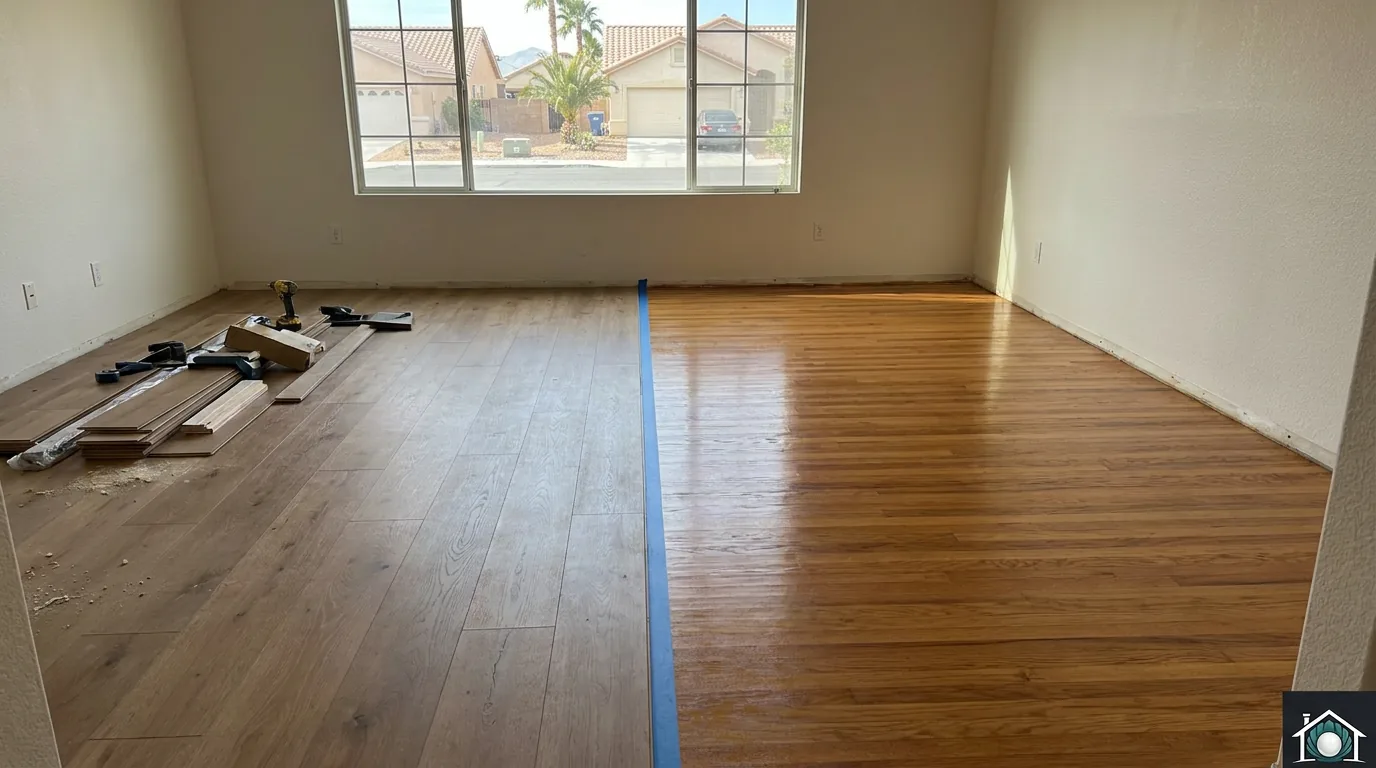
Hardwood floors in North Las Vegas homes age in predictable ways. The original installation looked beautiful for the first few years. Furniture stayed in the same spots and protected the wood underneath. The high-traffic paths from the front door to the kitchen and from the kitchen to the bedrooms slowly developed a sheen that was different from the protected areas. Pet nails added small scratches. A potted plant overflowed and left a dark water mark. Twenty years later, the floor reads as worn and tired even though the underlying wood is mostly fine.
The question every homeowner with aging hardwood eventually asks is whether to refinish the existing floor or replace it entirely. The honest answer depends on the type of floor, its current condition, and what the homeowner wants the result to look like - and the right choice usually saves significant money and disruption when it can be done. Here is how to evaluate which approach fits your specific North Las Vegas home.
What Refinishing Actually Means
Hardwood refinishing removes the existing finish from the wood, sands the surface back to bare wood, optionally applies a new stain to change the color, and then applies multiple coats of new finish (water-based or oil-based polyurethane is the modern standard). The result is essentially a brand-new floor surface using the existing wood underneath.
Full refinishing requires sanding the wood surface deeply enough to remove not just the finish but any surface-level damage - light scratches, small dents, water marks, sun-faded sections that need to be evened out. Each refinish removes 1/32 to 1/16 inch of wood thickness, which limits how many times a floor can be refinished over its lifetime.
The lighter alternative is a screen-and-recoat (sometimes called buff-and-coat). This abrades only the existing finish surface, then applies a new top coat. It does not address damage in the wood itself or change the stain color. It typically costs roughly half of a full refinish and takes much less time, but it only works on floors with surface wear and no underlying damage.
What Replacement Actually Means
Hardwood replacement removes the existing flooring entirely, prepares the substrate (typically a plywood subfloor), and installs new hardwood. The new flooring can be solid hardwood (single piece of wood, traditionally 3/4 inch thick) or engineered hardwood (a real wood top layer bonded to multiple plywood layers underneath).
For replacement projects in current North Las Vegas remodels, premium engineered hardwood has become the practical default. The reasons: better dimensional stability through Las Vegas’s significant temperature and humidity swings, the option to install over concrete slab (which solid hardwood cannot easily do), wider plank widths available (5 to 9 inch planks are common in current designs vs 2.25 to 3.25 inch planks typical in older solid floors), and faster install with click-lock or floating-floor systems.
Solid hardwood is still chosen by some clients who want the traditional look and the ability to refinish many times. The trade-offs are higher cost, more critical subfloor preparation, and worse performance in slab-on-grade installations (where most North Las Vegas homes are built).
Side-by-Side Comparison
| Attribute | Refinishing | Replacement |
|---|---|---|
| Typical cost (per sq ft) | [$3 - $7] full sand and refinish; [$1.50 - $3] screen-and-recoat | [$10 - $25+] including removal |
| Time on a 1,500 sq ft project | 4 - 7 days | 1 - 3 weeks |
| Disruption to home | Significant - floor unwalkable, some odor | Major - rooms emptied, dust, longer |
| Color change possible | Yes (new stain) | Yes (new product) |
| Wood species change | No | Yes |
| Plank width change | No | Yes |
| Underlying floor condition matters | Critical - wear layer must be sufficient | Less critical - existing floor removed anyway |
| Best when | Existing floor is structurally sound | Existing floor is too thin, damaged, or wrong style |
The economics favor refinishing dramatically when the existing floor allows it. A refinish project costs roughly one-third to one-half of a replacement project of similar scope and finishes in a fraction of the time.
When Refinishing Is the Right Choice
Refinishing is the right choice when several conditions are met:
The existing floor is solid hardwood with at least 3/16 inch of wear layer remaining above the tongue and groove. Most original North Las Vegas hardwood from the 1980s through early 2000s starts at 3/4 inch thickness and has been refinished zero or one times - meaning there is plenty of wear layer left for at least one more refinish.
The floor’s structural condition is sound: no significant water damage, no large gaps between boards from movement, no warped boards that cannot be flattened by sanding, no major squeaks indicating subfloor problems.
The wood species and plank width work for the homeowner’s intended look. A 2.25-inch red oak floor will still be a 2.25-inch red oak floor after refinishing - just with a fresh finish and possibly a new stain color. If the homeowner wants 7-inch wide-plank white oak, refinishing the existing floor will not get them there.
The damage on the existing floor is mostly surface-level: scratches, surface scuffs, sun-faded areas, minor dents that can be sanded out. Deeper damage like burn marks all the way through the wear layer, water staining that has penetrated deep into the wood, or large sections of damage from old pet accidents are harder to address through refinishing alone.
The budget constraint or disruption tolerance favors the smaller project. Refinishing costs roughly one-third the cost of replacement and takes roughly one-third the time.
When Replacement Is the Right Choice
Replacement is the right choice in the opposite scenarios:
The existing floor is engineered hardwood with a thin wear layer (less than 2 mm), laminate, or luxury vinyl plank - none of which can be refinished. When these floors wear through, they need replacement.
The wear layer on existing solid hardwood has been used up - typically the floor has been refinished 4 to 6 times already and the remaining thickness above the tongue and groove is too thin to safely sand again. A flooring contractor can measure this with a small probe in an inconspicuous spot.
The damage extends deeper than refinishing can fix: significant water damage to the wood itself, sections of severely warped boards, sections that have been damaged by previous flooring removal (where a part of the floor was already replaced and the patch is visible).
The desired look requires a different wood species, plank width, color, or pattern that refinishing cannot deliver. Going from narrow oak to wide-plank walnut means replacement.
A major remodel is happening anyway and the floor needs to come out for other work (new layout, new walls, slab repairs, plumbing work that breaks the floor).
Floor Conditions That Force the Decision
A few specific conditions essentially force one direction or the other:
Floor is laminate or LVP showing wear: replacement only. These products cannot be refinished.
Floor is engineered with thin wear layer: replacement is usually the only option, though specialized refinishing can sometimes work on engineered floors with thicker wear layers (3 to 6 mm).
Floor has significant water damage: depends on extent. Localized damage might be addressable through board replacement and refinishing of the surrounding floor. Widespread damage typically requires replacement.
Floor has been refinished multiple times already: measure the remaining wear layer. If less than 1/16 inch above the tongue and groove, replacement is needed.
Floor has structural subfloor problems (squeaks, soft spots, deflection): the subfloor needs to be addressed regardless of whether the surface flooring is refinished or replaced. Replacement is often easier because the floor needs to come up for the subfloor work anyway.
Cost in North Las Vegas
Refinishing pricing in North Las Vegas typically runs:
Full sand and refinish: [$3 - $7 per square foot]. Lower end is for floors in good condition with simple patterns and clear or natural finish. Higher end is for floors with significant prep work, custom stain colors, or multiple coats of premium finish.
Screen-and-recoat: [$1.50 - $3 per square foot]. Significantly less invasive but only works on floors with surface wear and no other issues.
Replacement pricing typically runs:
Engineered hardwood replacement: [$10 - $20 per square foot] installed for mid-range product, [$15 - $30 per square foot] for premium product. Includes removal of existing flooring, subfloor prep, and install.
Solid hardwood replacement: [$14 - $25 per square foot] installed for mid-range, [$22 - $40+] for premium. Higher than engineered due to material cost and more involved installation.
For a typical 1,500 square foot North Las Vegas main floor, refinishing usually falls in [$4,500 - $10,500] and replacement in [$15,000 - $45,000+], depending on product and scope. The cost difference is usually the deciding factor when both options are technically viable.
Process and Timeline
A refinishing project on a typical 1,500 square foot main floor:
Day 1-2: Sanding. Multiple passes with progressively finer sandpaper. Significant dust if traditional sanding (modern dustless systems significantly reduce but do not eliminate dust). Floor goes from existing finish to bare wood.
Day 3 (if staining): Stain application. The wood absorbs stain unevenly depending on grain and species, which is why a sample should be done on an inconspicuous area first to confirm the color reads as expected. Stain dries overnight.
Day 4-6: Finish coats. Two to four coats of polyurethane (water-based modern finishes typically need three to four coats; oil-based typically need two to three). Each coat needs to dry before the next is applied. The floor is walkable with socks after the second coat but should not have furniture or rugs on it for a week to ten days for full cure.
A replacement project on the same square footage:
Days 1-3: Removal of existing flooring, subfloor inspection and prep, addressing any deficiencies in the substrate.
Days 4-10: Installation of new flooring. Install pace depends on product type, plank width, and pattern complexity.
Days 11-14: Trim work, transitions, finish details, and final inspection.
The home is largely unusable in the rooms being worked during refinishing and significantly disrupted across multiple days for replacement. Most homeowners arrange to be elsewhere for 2 to 4 days during the most disruptive phases of either project.
Living Through the Project
A few practical tips that consistently help:
Plan to have the home empty (or nearly empty) for the disruptive days. The dust during sanding settles everywhere even with careful containment. Removing furniture and protecting cabinets and built-ins is a substantial part of the prep.
Modern water-based finishes have much lower odor than oil-based polyurethane and cure faster. The premium for water-based finish is usually worth the trade-off in odor and disruption.
Plan post-project for 7 to 14 days before putting heavy furniture back on the floor and 30 days before putting area rugs back. The finish needs to fully cure to handle weight without imprinting.
Pet households should plan for pets to be elsewhere during the project and for the first 24 to 48 hours after final coats. Pet nails on uncured finish leave permanent marks.
Planning the Project
A refinishing project in North Las Vegas typically runs 3 to 6 weeks total from first consultation to finished floor - 1 to 2 weeks for assessment, scheduling, and stain selection, 1 week of active work, and 1 to 2 weeks of cure time before normal use returns.
A replacement project typically runs 6 to 14 weeks total - 2 to 4 weeks for product selection, ordering, and lead time, then 1 to 3 weeks of active install, plus a few days of cure before normal use.
For projects timed around major events (holiday entertaining, family visits, listing the home for sale), build in buffer time for the cure phases. A floor that looks done at day 7 still needs another week before furniture goes back.
If you are weighing refinishing vs replacement for your North Las Vegas home, Pearl handles flooring assessments, refinishing, and full replacement projects across the valley. Request a free in-home consultation or call (702) 602-8385. We will look at the existing floor, measure remaining wear layer, identify what is realistically achievable through refinishing, and put together a plan and quote for the right approach.