The countertop choice is one of the more consequential decisions in any kitchen remodel - the surface that gets touched dozens of times a day, that defines the visual feel of the room, and that has to perform for decades. Granite was the default in Las Vegas kitchens for most of the 2000s. Quartz took over in the 2010s and remains the most-installed material across the valley. Porcelain slab has emerged in the past five years as a serious alternative that is gaining ground each year, particularly in higher-end remodels and in outdoor kitchen applications.
For a Spring Valley kitchen remodel in 2026, the realistic countertop choice is between quartz and porcelain in most cases. Both perform well in this climate, both have a wide range of looks available, and both will outlast the cabinets they sit on. The differences are real but specific, and the right choice depends on how the kitchen actually gets used. Here is an honest comparison.
What Quartz Actually Is
Quartz countertops (the engineered stone product, not the natural quartz crystal mineral that the name borrows from) are made by combining roughly 90 to 95 percent ground natural quartz particles with 5 to 10 percent polymer resin and pigments. The mixture is compressed and cured into solid slabs typically 1.25 inches thick.
The result is a non-porous, hard, dimensionally stable surface that is consistent slab to slab and available in essentially unlimited color and pattern variations. The most common patterns mimic natural marble (Calacatta, Carrara, Statuario), travertine, and limestone, with subtle to dramatic veining options. Solid colors and modern textures are also widely available.
The polymer resin is the key to quartz’s strengths and its limitations. The resin gives quartz its non-porous, stain-resistant surface (no sealing required, ever), but the same resin softens under heat. The major manufacturers all recommend trivets for hot pans because direct heat can scorch, soften, or discolor the resin permanently.
What Porcelain Slab Actually Is
Porcelain slab countertops are large-format porcelain tiles - typically 5 by 10 feet or 5 by 12 feet - made from refined clay fired at extremely high temperatures (over 2,200 degrees Fahrenheit). The result is a fully vitrified, dense, hard, non-porous material with no resin or organic content.
Porcelain is dimensionally thinner than quartz - typical thicknesses are 0.25 inch, 0.5 inch, or 0.75 inch, with an option to fabricate to look thicker by mitering the edge to a deeper apparent profile. The thinness opens up applications that quartz cannot easily do (overlay over existing counters, exterior cladding, vertical applications) and allows for very contemporary slim countertop profiles.
Porcelain patterns are printed and fired into the slab, then sealed under a final glaze layer. The pattern technology has improved dramatically in recent years - current porcelain slab from major manufacturers is essentially indistinguishable from natural marble, travertine, or limestone in appearance. The biggest visual difference between cheap and premium porcelain is whether the pattern feels mechanical (cheap) or organic and varied (premium).
Side-by-Side Comparison
| Attribute | Quartz | Porcelain Slab |
|---|---|---|
| Composition | 90 - 95% quartz + polymer resin | Fully vitrified porcelain, no resin |
| Standard thickness | 1.25 inches | 0.25, 0.5, or 0.75 inch |
| Heat resistance | Limited - trivet required | Excellent - hot pans direct |
| Stain resistance | Excellent | Excellent |
| Sealing required | No | No |
| Scratch resistance | Good | Excellent |
| Edge chip resistance | Moderate | Lower (brittle) |
| UV / sun resistance | Moderate (resin can yellow over years) | Excellent (UV stable) |
| Outdoor use | Not recommended | Yes, fully suitable |
| Pattern range | Very wide | Very wide and growing |
| Installed cost (per sq ft) | [$60 - $150] | [$80 - $180] |
| Fabrication complexity | Moderate | High - thin and brittle, skilled fabricator required |
| Waterfall edges | Common, beautiful | Common, allows slimmer profile |
| Bookmatched slabs | Available in higher-end patterns | Strong option, large-format slabs make impressive bookmatched walls |
The pattern is consistent. Quartz is the more forgiving choice for typical kitchen use, with limitations around heat. Porcelain matches or exceeds quartz on most performance metrics but costs more and requires a skilled fabricator who knows how to handle the material.
Heat Resistance - The Las Vegas Specific Concern
The heat-resistance difference matters more in Las Vegas kitchens than in cooler climates for two reasons. First, kitchens here often run hotter than in more temperate climates - large windows let in significant solar heat gain, ventilation may be limited, and the cooktop adds substantial heat during cooking. Second, the homeowners who ask about porcelain are often the ones who have damaged a previous quartz counter by setting a hot pan down without thinking.
If the household consistently uses trivets and hot pads, quartz is fine. If the household includes a busy cook who pulls pans straight from the cooktop or oven and sets them down on the nearest surface, porcelain dramatically reduces the risk of permanent damage. The difference is not abstract - quartz scorch marks from direct heat are visible and not removable.
This is one of the few decisions where the honest assessment of household behavior should drive the choice. Aspirational behavior (“we’ll always use a trivet”) often does not match real behavior over years of cooking.
Aesthetic Differences
Both materials are available in essentially unlimited patterns, colors, and finishes. The aesthetic differences are subtle:
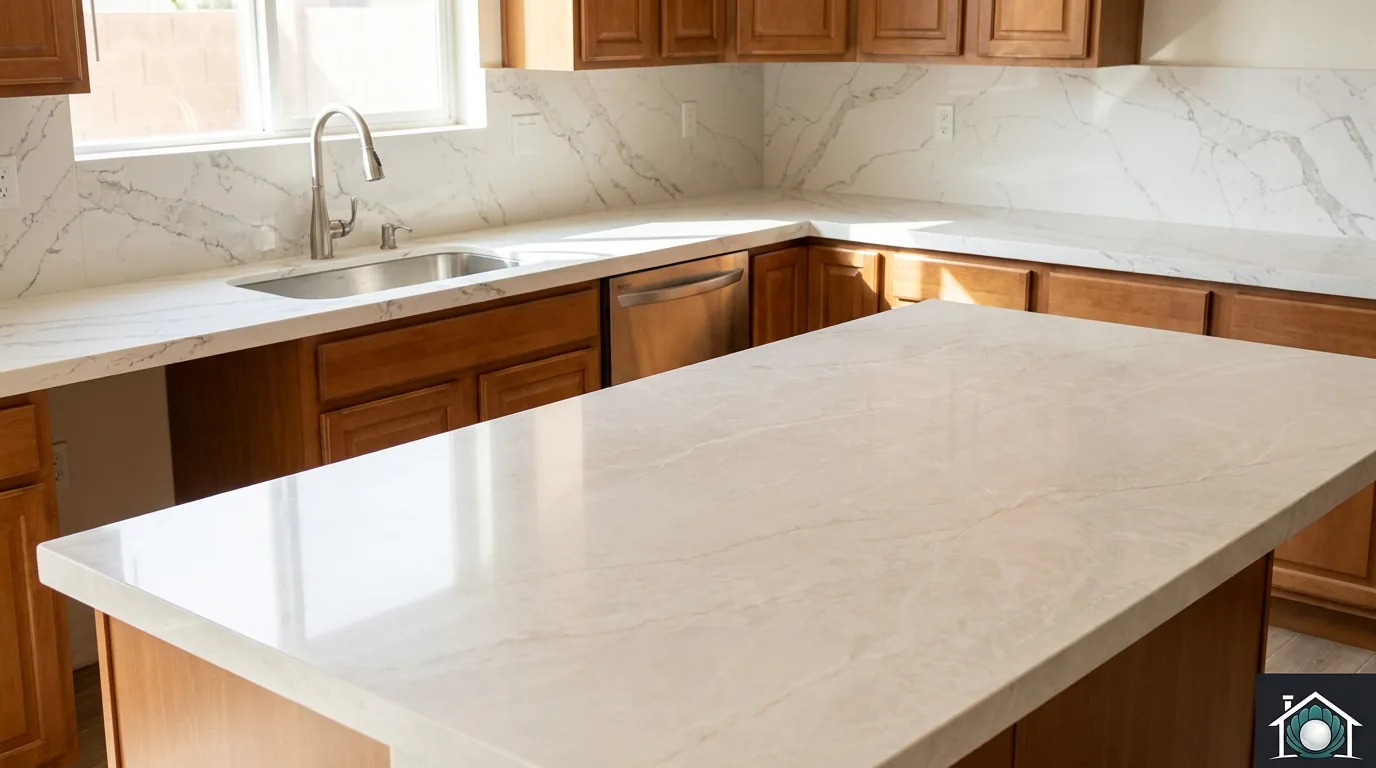
Premium quartz with bookmatched slabs, dramatic veining, and brushed finishes can be nearly indistinguishable from natural marble at a casual glance. The veining is typically printed and embedded throughout the slab, so the pattern continues at exposed edges and through the thickness.
Premium porcelain slab patterns are printed on the surface and sealed under glaze. The pattern is highly realistic, but at exposed edges (mitered corners, sink cutouts) the pattern can show its surface-only nature unless the fabricator carefully addresses edge treatment. Modern fabrication techniques largely solve this with mitered edges that wrap the pattern around the corner.
For most homeowners, the visual difference between premium quartz and premium porcelain is small. The visible-pattern difference between either premium product and a cheaper version of the same material is much larger than the difference between the two materials at the same tier.
Maintenance Reality
Both materials are essentially zero-maintenance compared to natural stone. Daily care is the same: wipe with mild soap and water, dry with a soft cloth. Neither requires sealing, ever. Neither is damaged by common kitchen products (mild detergents, vinegar, citrus juice, wine).
Two specific maintenance differences:
Hard water spots show on both materials but are more visible on dark quartz than on dark porcelain. A soft cloth and a small amount of stone cleaner removes them on either material.
Cooking-oil residue can build up over time on either surface. A diluted dish-soap solution on a soft cloth is the standard fix. Avoid abrasive scrubbers and harsh chemicals on either material.
The often-cited “porcelain is harder to clean” concern is not borne out in practice for the major-brand porcelain slab products. The glazed surface cleans similarly to quartz.
When Quartz Is the Right Choice
Quartz is the right choice when budget is a factor and a quality mid-range product is preferred over a premium specialty product; when the household uses trivets reliably and heat resistance is not a primary concern; when the kitchen does not have large unshaded south or west windows that would expose the counter to constant direct sun; when the project includes only the indoor kitchen, not outdoor extensions; or when the look the homeowner prefers is most readily available in quartz patterns.
For most Spring Valley kitchen remodels, quartz remains the default choice. It performs reliably, looks beautiful, costs less than porcelain on average, and is the material the broader fabrication market is most experienced with.
When Porcelain Is the Right Choice
Porcelain is the right choice when heat resistance matters - either because the household consistently puts hot pans down or because the homeowner wants to never have to think about it; when the project includes outdoor kitchen, pool deck, or exterior applications and the homeowner wants a single material running across all surfaces; when a slim counter profile (less than 1.25 inches) is part of the design; when waterfall edges or large-format bookmatched slabs are central to the design; or when the kitchen has large windows that load the counter with direct UV daily.
Porcelain is also a strong choice for higher-end remodels where the fabrication skill of the installer can showcase the material’s strengths (mitered edges, bookmatched slabs, integrated sinks).
Cost in Spring Valley
Quartz countertops typically run [$60 - $150 per square foot] fully installed in Spring Valley. The lower end of the range is mid-tier quartz from major brands; the upper end is premium patterns with bookmatched slabs, complex edges, and high-detail fabrication.
Porcelain slab countertops typically run [$80 - $180 per square foot] fully installed. The premium over quartz reflects the fabrication complexity (thinner, more brittle material requires more careful handling) and the somewhat smaller pool of fabricators who specialize in porcelain.
For a typical 50 to 80 square foot kitchen counter run, the total cost difference between quartz and porcelain at the same tier is usually [$1,500 - $3,500]. Within the context of a [$45,000 - $120,000] kitchen remodel, the upgrade cost from quartz to porcelain is usually a small percentage of the total project.
Installation Considerations
A few practical points worth confirming with the installer regardless of material:
- Slab selection in person at the slab yard, not from a sample chip. Patterns vary slab to slab and the look of a 5 by 10 foot slab is different from a 4 by 4 inch sample.
- Edge profile choice (eased, mitered, ogee, beveled) - mitered edges look the most contemporary on both materials.
- Sink cutout style (undermount, drop-in, integrated) and whether the cutout will be reinforced for the sink weight.
- Backsplash strategy and how the counter terminates at the wall.
- Seam locations and whether the layout minimizes visible seams.
Planning the Project
A standalone countertop replacement project typically takes 3 to 6 weeks total - 1 to 3 weeks for slab selection and template, 1 to 2 weeks for fabrication, and 1 to 2 days for installation. As part of a full kitchen remodel in Spring Valley, the countertop install slots in after cabinets are set and before the backsplash, plumbing trim, and appliances.
If you are planning a kitchen remodel and weighing the quartz vs porcelain choice, Pearl handles material selection, fabrication coordination, and installation across Spring Valley and the rest of the valley. Request a free in-home consultation or call (702) 602-8385. We will walk through how you actually use the kitchen, weigh the trade-offs, and put together a realistic plan and quote.