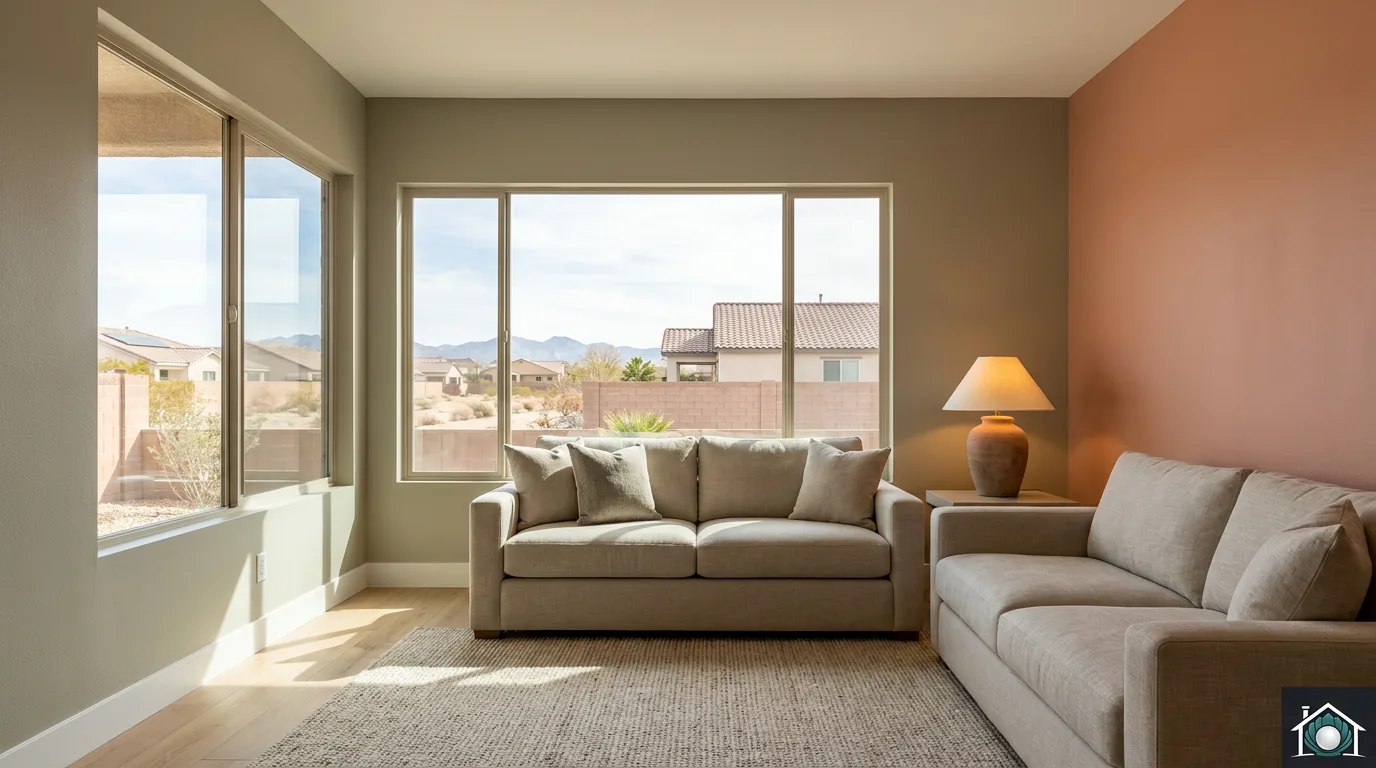
Green Valley homes get serious sun. The submarket sits at the eastern edge of the Las Vegas Valley with expansive south- and west-facing exposures across most of the master-planned developments. Many of the homes have generous sliding doors and large windows that let in beautiful natural light - and dump significant UV onto the walls behind them every afternoon. The wrong paint choice in a sun-loaded living room becomes visible within a couple of years: faded values, color drift between sun-exposed and shaded walls, and patches where artwork was hanging that no longer match the rest of the wall.
The right paint choice does not just look good on the day it goes on the walls. It looks good five years later, ages gracefully across all the rooms in the home, and matches the warm desert light that defines daytime in Green Valley. Here is how to think about color choice for sun-exposed Green Valley homes, and which palettes consistently work.
Why Sun Exposure Matters for Interior Paint
Pigments fade under UV radiation. Some pigments fade fast, some fade slowly, and a small set of inorganic pigments are essentially permanent. For exterior paint this matters obviously - the paint takes direct sun all day. For interior paint it matters less obviously but still significantly, especially in rooms with large south- or west-facing windows.
Interior UV exposure in a sun-loaded Green Valley room is roughly 10 to 20 percent of exterior intensity, depending on glazing. That sounds modest until you realize it is sustained for five to seven hours a day across hundreds of days a year. The cumulative effect over five to ten years is substantial color shift on sun-loaded walls.
Color also reads differently across the day in any room with significant natural light. A wall color that looks soft and creamy at 10 AM can look harsh and bright at 2 PM and warm and dusty at 5 PM. The color sample held against the wall on a Saturday morning tour rarely captures the way the color will look across the full daily light cycle. The successful colors in sun-loaded rooms are the ones that look pleasant across all of those conditions, not just one.
The Color Families That Consistently Work
Five color directions consistently age well in sun-exposed Green Valley homes.
Warm whites and creams are the most forgiving choice. Soft warm white, alabaster, ivory, bone, and warm linen tones reflect light pleasantly without reading as stark or clinical. They hide minor sun-related fade because the values are already light, and they harmonize with the warm wood tones that dominate current Green Valley remodels. The right warm white is one with a subtle yellow, peach, or pink undertone rather than a pure white or a cool blue undertone.
Greiges and warm beiges are the dominant palette across current Green Valley interior remodels. Greige (grey-beige), mushroom, sand, warm taupe, and similar colors sit comfortably between traditional and contemporary, work with both warm wood and white kitchens, and use UV-stable iron-oxide-based pigments that age well. The most successful greiges have a warm undertone rather than a cool grey undertone.
Soft sage and muted olive bring color into the home without the fade risk of saturated greens. Soft sage works particularly well in living areas, bedrooms, and powder rooms, and pairs cleanly with white-oak floors and warm white trim. Muted olive is a slightly bolder choice that reads sophisticated and ages gracefully.
Dusty terracotta and warm clay tones have grown in popularity in current Green Valley remodels. They bring warmth and connection to the desert landscape outside without reading as dated or themed. Terracotta works particularly well as an accent wall, in dining rooms, or in spaces where a richer warm tone is desired.
Soft warm grays (specifically warm grays - cool gray-blues do not age as well in this climate) work in homes that lean transitional or contemporary. The key word is warm - grays with a slight beige or taupe undertone hold up; grays with a blue or green undertone read cool and read dated faster in sun-loaded rooms.
Colors That Fade Fast (and How to Use Them Anyway)
Some colors are simply hard to maintain in sun-loaded Green Valley rooms. The pigments that fade fastest under sustained UV are concentrated in the saturated-and-deep range:
- True reds, deep oranges, and saturated terracotta in the unmuted spectrum
- True blues, navy in some formulations, and bright purples
- Bright synthetic greens (kelly green, lime, emerald)
- True black on large walls (absorbs heat, fades to charcoal grey within a few years)
This does not mean these colors cannot be used in a Green Valley home. It means they need to be used strategically. Bold colors work well on a small accent wall in a low-sun room (north-facing bedroom, dining room with limited windows), on the inside of a powder room with no window, on cabinetry rather than walls, or as part of a planned 4-to-6 year refresh cycle in a small area where repainting is easy.
The mistake is using a high-fade color as a primary body color in a south- or west-facing living room. The fade will be visible within 3 to 5 years and uneven across the room - a wall that gets direct afternoon sun will fade faster than the wall opposite it.
Sheen and Finish for Sun-Loaded Rooms
The sheen choice affects both how the color reads and how the wall ages. The standard guidance for Green Valley living areas:
Walls in living areas, bedrooms, and dining: matte or eggshell finish. Matte hides minor wall imperfections (which become more visible in sun-raked light), reads sophisticated, and provides a soft visual anchor. Eggshell offers a slight sheen that holds up better to cleaning than flat matte and works well in family rooms or kitchens.
Walls in kitchens and bathrooms: eggshell or satin. The slightly higher sheen handles moisture, splashes, and frequent cleaning better than matte. Modern matte products are often washable and can work in kitchens too, but satin remains the safer choice in high-use areas.
Trim, doors, and cabinetry: semi-gloss or satin. Higher sheen reads as a deliberate architectural element, holds up to handling and cleaning, and contrasts with matte walls in a way that defines the room’s geometry.
Ceilings: flat. Anything with sheen on a ceiling shows imperfections and creates glare from light fixtures.
Avoid high-gloss on walls in Green Valley homes. The reflectivity is unforgiving in sun-loaded rooms and shows every imperfection. High-gloss has its place on furniture, certain doors, and specific accent details, but rarely on walls in this climate.
Paint Quality Matters More Than People Think
The retail paint market spans a wide quality range, and the difference between contractor-grade paint and premium paint is meaningful in the long run. Premium paints have higher pigment loading (richer color and longer fade resistance), better resin systems (more UV stability and adhesion), better hide (often allowing two coats where lower-tier paints need three), and better wash-ability after cure.
For Green Valley interiors, premium paint typically costs [$50 to $90 per gallon] vs [$25 to $50 per gallon] for contractor-grade. Across a whole-house repaint that needs roughly 10 to 20 gallons of paint, the upgrade adds [$300 to $1,000] to project cost - a small percentage of total project budget for measurably better aging.
The major manufacturers all offer multiple tiers. The premium tiers from each major brand perform well in this climate. The bottom of the line products from any brand do not.
Accent Walls and Trim Strategy
Strong whole-house schemes typically use a calm body color throughout the main living areas, a coordinated trim color, and accent moments where they add interest. The pattern that consistently works:
The body color is one of the warm-neutral palettes above, used consistently across the kitchen, living room, dining, hallways, and most bedrooms.
The trim color is either crisp white, warm white, or a half-shade lighter or darker than the body color. White trim is the safe and timeless choice. Body-tone trim (slightly different from the wall) reads more sophisticated but requires careful sample testing.
Accent walls work selectively - not in every room. The strongest accent walls are in dining rooms (where the color anchors a defined zone), bedrooms (where a single feature wall behind the bed adds depth), powder rooms (where bolder color is acceptable in a small space), and home offices (where a stronger color can support focus).
The mistake to avoid is using accent walls or contrasting colors in too many rooms. A home with accent walls in five different rooms reads chaotic; a home with accent walls in one or two well-chosen spots reads intentional.
The Whole-House Approach
A whole-house repaint is the single highest-impact aesthetic refresh available to a Green Valley homeowner short of a major remodel. The right approach treats the home as a connected sequence of rooms rather than as individual paint jobs:
The body color flows continuously across the public areas - kitchen, living room, dining, hallways. Different rooms can have different secondary or accent colors, but the connective tissue (walls in the open and shared spaces) reads as one design choice.
Trim color is consistent throughout the home. White trim in the living room and beige trim in the bedroom rarely works.
Door color is consistent within the home. Either all doors match the trim, all doors are a single deliberate accent color, or interior doors are one color and the front door is a separate statement.
Bedrooms get the freedom to have individual personality but should still relate to the whole-house palette - a sage green bedroom in a warm-greige house works; a lavender bedroom in the same house reads disconnected.
Bathrooms can take more saturated or unusual colors because they are smaller and more enclosed. A small powder room in a deep green or terracotta can be a delightful counterpoint to a calm whole-house body color.
What It Costs and How Long It Takes
Interior repainting in Green Valley typically runs [$3 - $7 per square foot] of finished area, including prep (patching, sanding, caulking), primer where needed, and two coats of premium paint. A typical 2,000 to 2,500 square foot home runs [$6,000 - $17,000] for a full interior repaint. Single-room repainting typically runs [$400 - $1,200] depending on size, ceiling height, and complexity.
A full-house interior repaint typically takes 4 to 8 days of active work depending on home size, with 1 to 2 days of prep, 2 to 4 days of painting, and 1 to 2 days of touch-up and detail work. The home is largely usable throughout but the rooms being painted are off-limits during the work and for 12 to 24 hours after for cure.
Pearl handles full-house interior repainting and accent work for painting projects in Green Valley and the rest of the valley. If you are planning a refresh and want to walk through color directions and product choices that fit your home’s specific exposures, request a free in-home consultation or call (702) 602-8385. We will look at the home’s natural light at different times of day, talk through palettes that work, and put together a realistic plan and quote.