
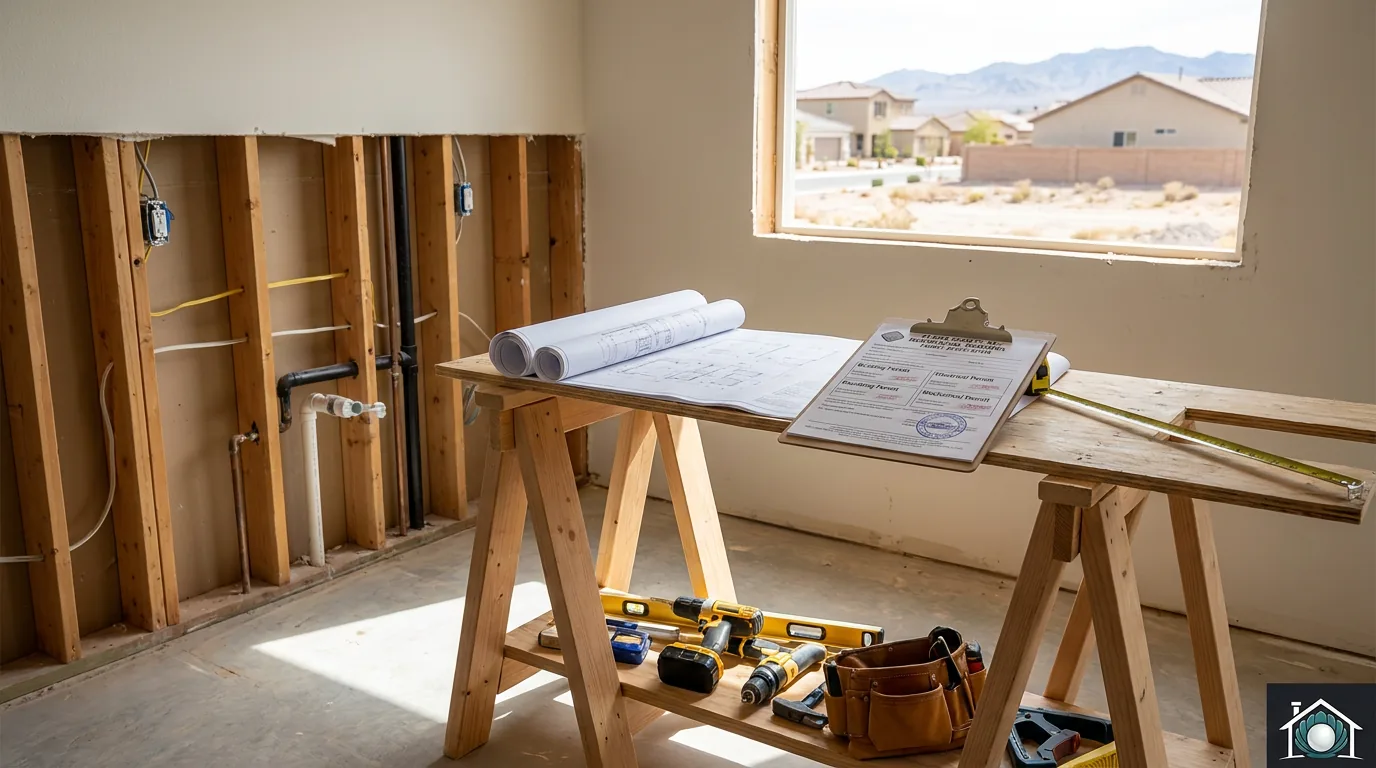
Permits are the part of a remodel nobody enjoys thinking about until they cause a problem. They are also the part that quietly determines whether the project is legitimate work that adds value to the home, or a future headache waiting to surface at the next inspection, insurance claim, or sale.
If you are planning a remodel anywhere in the Las Vegas Valley, the permitting question is one of the first things to sort out. Here is what counts as permittable work in Clark County, which projects can skip the process, who actually pulls the permit, what it costs, and what happens to homeowners who try to dodge it.
Which Jurisdiction Are You Actually In
The first thing to figure out is where the permit comes from. Many homeowners assume “Clark County” because that covers the entire valley, but several incorporated cities run their own building departments. The jurisdiction depends on your physical address, not your mailing address.
| Address falls in | Permit office |
|---|---|
| Unincorporated Clark County (Paradise, Spring Valley, Enterprise, Summerlin South, Sunrise Manor, Whitney, much of “Las Vegas” by mailing address) | Clark County Department of Building and Fire Prevention |
| City of Las Vegas (the actual incorporated city limits, mostly the older urban core and some northwest neighborhoods) | City of Las Vegas Department of Building and Safety |
| City of Henderson | City of Henderson Building Department |
| City of North Las Vegas | City of North Las Vegas Land Development and Community Services |
| City of Boulder City | City of Boulder City Building Department |
A common surprise: a large share of homes with “Las Vegas, NV” mailing addresses are technically in unincorporated Clark County, including most of Summerlin, Paradise, Spring Valley, and Enterprise. The Clark County Assessor lookup will tell you for certain. Pulling a permit from the wrong jurisdiction wastes the fee and delays the project.
What Requires a Permit
The general rule is that any work affecting the structure of the home, the utilities running through it, or the life-safety systems requires a permit. Cosmetic refresh work generally does not. The most common remodel categories that always require a permit:
Structural changes including any wall removal, opening a load-bearing wall, adding or moving a beam, room additions, second-story additions, and detached structures. Patio covers attached to the home, casitas, detached ADUs, and any structure with a permanent foundation or attached roof tie-in all need permits regardless of size.
Electrical work that adds circuits, moves a panel, runs new wiring, adds a sub-panel, or modifies the service. Like-for-like outlet replacement does not, but a kitchen or bathroom remodel virtually always triggers electrical work that does.
Plumbing work that moves a fixture (sink, toilet, tub, shower), reroutes drain lines, or modifies supply lines. Replacing a faucet or a toilet on the existing rough-in does not require a permit; moving the toilet two feet to the left does.
Mechanical work including HVAC changeouts (furnace, condenser, ductwork), gas line modifications, water heater replacements, and bath fan additions or relocations.
Roofing including a full re-roof, structural changes to the roof framing, and skylight installation.
Pool and spa work including new builds, structural alterations, and pool equipment additions that involve electrical or gas.
Solar panel installations, EV charger installations on dedicated circuits, and standby generator installations.
A kitchen or bathroom remodel that touches plumbing or electrical - which is almost all of them - falls into multiple permit categories at once. The general contractor or remodeling firm packages those into one permit application with the appropriate trade sub-permits attached.
What Generally Does Not Require a Permit
The categories below typically do not require a permit in Clark County. These rules are similar across the cities but verify locally before relying on them:
Cabinet replacement on the same footprint, with no plumbing or electrical changes. Countertop replacement. Interior painting. Flooring replacement (LVP, hardwood, tile) when the subfloor and structure stay the same. Light fixture swaps on existing wiring. Faucet, toilet, or sink replacement on existing rough-in. Drywall patching and refinishing.
There are gray areas. Replacing kitchen cabinets often triggers small electrical changes (under-cabinet lighting, dishwasher disconnect updates), which then does require an electrical permit. Replacing flooring is usually permit-free, but if it involves leveling the subfloor structurally, it may not be. When in doubt, ask the building department or have your contractor make the determination. A 10-minute phone call is much cheaper than a stop-work order.
Who Pulls the Permit
In nearly every Clark County jurisdiction, a licensed contractor is the right party to pull the permit. The contractor is legally responsible for the work meeting code, schedules and meets the inspections, and absorbs the liability if something fails inspection. Their license is on the line, which is exactly why a real remodeling firm builds permits into the project from the start rather than treating them as optional.
Homeowner permits are allowed in some categories on a primary residence (not a rental), but the homeowner then becomes the legal “contractor of record” and assumes responsibility for inspection scheduling, code compliance, and any later issues that surface. For a small project a homeowner is doing themselves - swapping a water heater, replacing a roof on a detached garage - this can work. For a full remodel coordinated by a contractor, the contractor should pull it. If a contractor refuses to pull a permit or tries to talk you into pulling a homeowner permit so they do not have to, that is a major red flag.
What It Actually Costs
Permit fees in Clark County are not a fixed sticker price. They are calculated as a function of the declared valuation of the work plus per-trade fees, plus plan-check fees on projects that require review. Rough ranges for typical Las Vegas Valley remodels:
A simple permit (water heater changeout, single re-roof, electrical sub-panel swap) usually lands in the [$150 - $500] range. A standard kitchen or bathroom remodel permit package, including the building permit plus plumbing, electrical, and mechanical sub-permits, typically falls in the [$500 - $2,500] range. A larger whole-house remodel, addition, or new detached structure tends to run [$2,000 - $8,000+] depending on the valuation and scope. Pool, solar, and spa permits have their own separate fee structures.
These ranges are general industry numbers for the local market and depend on the specific scope, valuation, and jurisdiction. Re-inspection fees apply if a failed inspection requires a return visit, which is one of many reasons a competent contractor matters - inspectors get to know who passes the first time and who doesn’t.
How Long the Process Takes
A few simple projects qualify for over-the-counter permits and issue the same day - a water heater swap, a simple re-roof on an existing structure, a straightforward electrical service upgrade. The contractor or homeowner walks into the building department, submits, pays, and walks out with the permit.
Most remodels require plan review. A standard kitchen or bathroom remodel package typically clears plan review in 2 to 6 weeks depending on department workload and how complete the submission is. Larger or more complex projects - additions, structural work, detached structures - usually take 4 to 10 weeks. Resubmissions after plan-review corrections add 1 to 3 weeks each round, which is why submission quality matters: a clean first submission saves the project several weeks compared to one that gets red-lined and bounced back.
The permitting timeline runs in parallel with design, cabinet ordering, and material lead times. A competent contractor schedules the permit submission early so it does not become the bottleneck that holds up demo and construction.
HOA Approval Stacks on Top
Permits are issued by the city or county. HOA approval is separate, and most master-planned communities in the valley require their own architectural review on exterior work, additions, detached structures, paint changes, landscaping, and sometimes window or door changes. Interior remodels generally do not require HOA approval, but exterior work almost always does.
HOA architectural review typically runs 2 to 6 weeks on top of the building permit timeline. Some communities require HOA approval before the building department will accept the permit application; others accept either order. Have your contractor sort out the sequence for your specific community.
What Happens When You Skip the Permit
Unpermitted work is more common than it should be in older Las Vegas neighborhoods, mostly from previous owners or fly-by-night contractors. The problems it creates surface in three ways:
The first is during inspection. If the building department finds out about unpermitted work in progress - a neighbor reports it, an inspector drives by, a related permit triggers a site visit - the project gets red-tagged. Work stops. The homeowner is required to expose, inspect, and bring the work to code retroactively. That almost always costs significantly more than the original permit would have, because finished work has to be opened back up, inspected, and reclosed.
The second is at resale. Real estate inspections and appraisals catch unpermitted work routinely. The buyer’s agent flags it, the buyer demands either remediation or a price concession, and the deal either falls apart or closes at a lower price. The cost of bringing unpermitted work to code at resale time is often 2 to 5 times the original permit cost, because the homeowner is now paying under pressure with no leverage.
The third is at insurance claim time. Some carriers will deny claims related to unpermitted work, particularly when the cause of loss is connected to the unpermitted work (an electrical fire from unpermitted wiring, water damage from an unpermitted plumbing job). The cost of an unfunded loss can dwarf the permit fee by several orders of magnitude.
The math is straightforward. A [$500 - $2,500] permit package on a [$50,000 - $100,000] remodel is a tiny fraction of the project cost. The cost of getting caught is many times higher. There is no reasonable scenario where skipping the permit pays off.
How a Reputable Contractor Handles This
When you talk to a remodeling firm about a project anywhere in the Las Vegas area, the permit conversation should happen on the first walk-through, not after the contract is signed. The contractor should know which jurisdiction the home falls in, identify which trade permits the project will require, give you a realistic permitting timeline, and roll the permit fees into the quote as a line item (not buried as overhead).
If a quote comes in significantly lower than other quotes for the same scope and there is no permit line, that is usually where the gap is. The cheap quote is the one planning to do the work without pulling. The savings on paper become a problem on the back end.
Pearl handles permitting end-to-end on every project we run, whether it falls in Clark County, the City of Las Vegas, Henderson, or North Las Vegas. If you are planning a remodel and want to walk through what permits your specific project will need, request a free in-home consultation or call (702) 602-8385. We will identify the jurisdiction, scope the permits, and roll them into a realistic plan and quote.